Mavlon-Buva Complex — Namangan Region📜 History & Heritage

In this article

2/6/2026

Mavlon-Buva Complex — Namangan Region

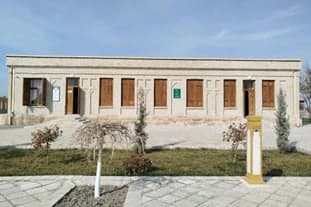
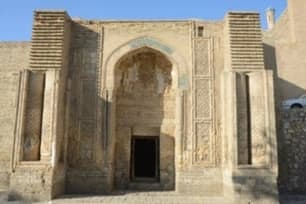
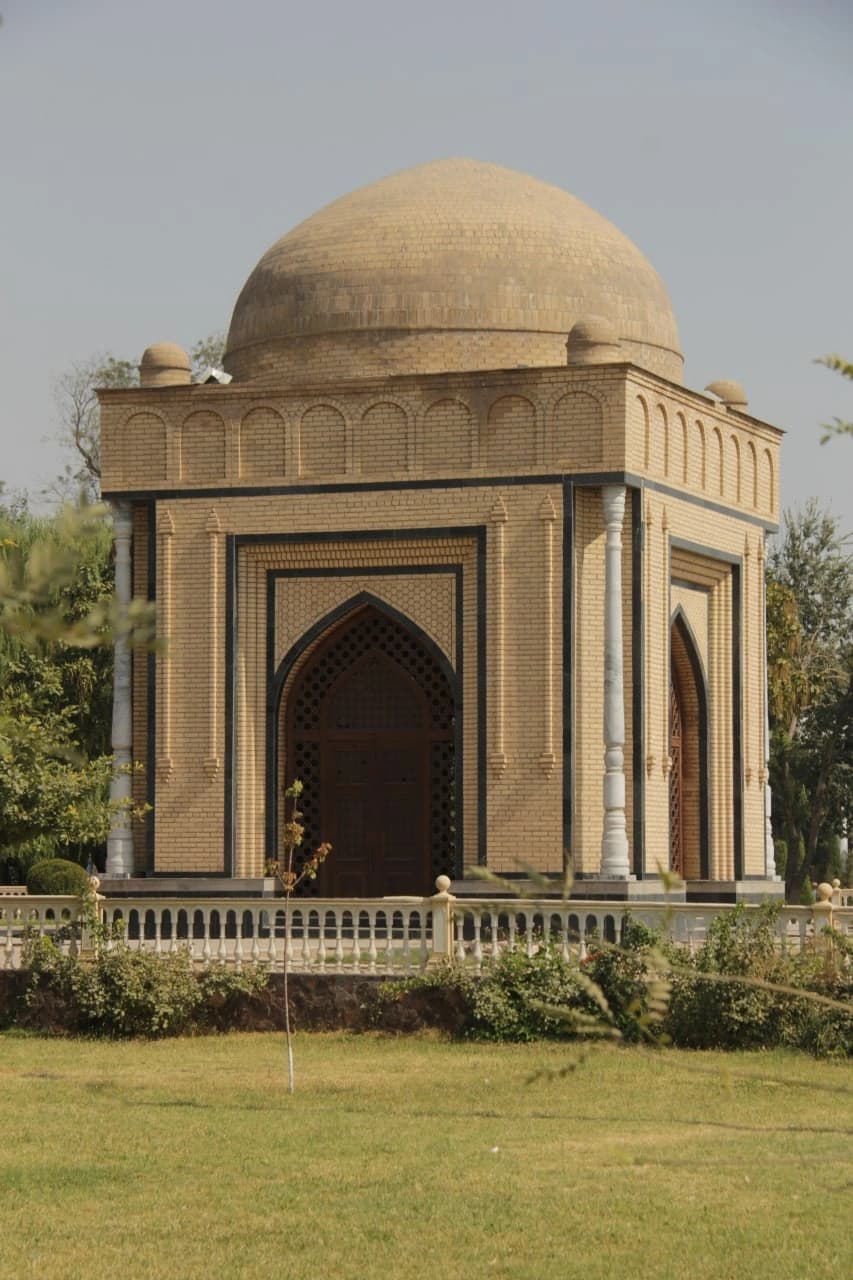
The Mavlon-Buva Complex was built in 1806 and is one of the important historical and architectural monuments of Namangan. The construction date is indicated above the entrance as the year 1221 Hijri. The complex is associated with the famous poet Mavlon-Buva (Mavlavi Namangani), who was buried here.

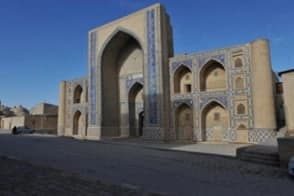
The complex stands out with its majestic portal, spear-shaped arch, and high niches. On both sides of the entrance are three-tiered decorative columns with a conical shape. Behind the portal lies a pilgrimage hall measuring 7×7 meters. The upper part of the facade is decorated with an ornamental arcade, while the rest consists of smooth brickwork.

The interior is decorated with carved ganch and paintings. The walls feature a mihrab image, vases with flowers, and geometric patterns. Poems written in Arabic calligraphy enrich the epigraphic decoration of the complex. The colorful ceiling with geometric and star-shaped ornaments is one of the most elegant parts of the complex.

The complex was restored in 1875, 1905, and 1957. Today it is one of the important pilgrimage and historical sites of Namangan region.

Read more

Kuhna Ark Palace

📜 History & Heritage

Kuhna Ark Palace

Kuhna Ark Palace

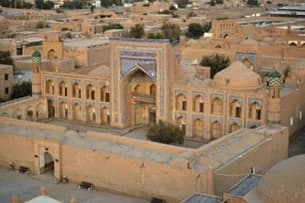
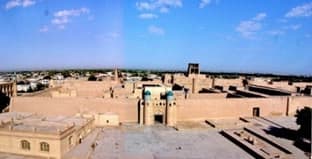
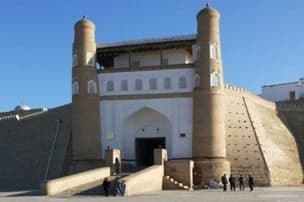
Kuhna Ark Palace is the ancient citadel of Khiva and one of the khan’s residences located within Ichan-Qala. The history of the fortress is closely connected with the history of the city of Khiva itself. Some historical sources indicate that the construction of the fortress and the city began at the same time. However, today only several buildings dating back to the 19th century have been preserved within the Ark territory.

The Ark once housed the residences of the khan and officials, as well as state institutions. It also included a reception hall (Salomkhona, Arzkhona), a mint, summer and winter mosques, a harem, an arsenal, a gunpowder workshop, storehouses, a kitchen, stables, a prison, and even a special arena for ram fighting.

The term “Kuhna Ark” (Old Fortress) began to be used after another palace, Tosh-Hovli, was built in the city between 1832 and 1838. In its structure and layout, the Ark resembles a city within a city. One side is bordered by the walls of Ichan-Qala, while the other sides are enclosed by special defensive walls. The Ark can be accessed only through one entrance — the eastern gate.

Its territory covers more than one hectare and has a rectangular shape (123 × 93 meters), surrounded by high, thick defensive walls. Kuhna Ark consists of four courtyards of different sizes.

In the western part of Kuhna Ark stands the Aq Shaykh Bobo pavilion, which, according to legend, was associated with Sheikh Mukhtar Vali, who lived in the 14th century. It is said that an elderly man dressed in white once lived there, which is why the hill became known as Aq Shaykh Bobo. In fact, this hill served as an observation point of the khan’s palace, offering a clear view of the surrounding city.

Address: Khiva city, “Ichan-Qala” neighborhood, A. Boltayev Street.

February 27, 2026